


We may earn from ads and some links. How we work.
When someone writes to me about a faith tattoo, they rarely start with a long scene. They start with a symbol. A cross they keep drawing in the margin of a notebook. A fish they saw on a wrist in a grocery line. A dove they cannot quite picture at the right size.
This guide walks through the Christian tattoo symbols readers ask about most, what they have meant in church history, and the practical things I would take into a consult: size, placement, script versus picture, and how fine lines hold once they heal. If you already know you want scripture itself rather than a mark, I wrote a companion piece on short Bible verse tattoos that covers wording, translation and letter height.
I am not a pastor or a church historian. I collect designs, talk with readers before they book and look closely at how real pieces sit on skin. If a symbol is important in your denomination, check the meaning with someone you trust before it becomes permanent.
Start with the meaning you actually want to carry
Two people can wear the same cross and mean very different things by it. One might want a quiet reminder of a verse they pray when they are afraid. Another might want a family mark that matches a parent or a child. That difference should change the design. A matching pair of tiny crosses on the inner wrist is not the same job as a larger ornamental cross on the forearm.
Before you fall in love with a picture, write one sentence about why you want it. Take that sentence to your artist. It will help them choose line weight, ornament and size, and it will stop the design from picking up extra swirls that do not belong to your story. I go into that kind of prep in more detail in Your First Tattoo, Step by Step.
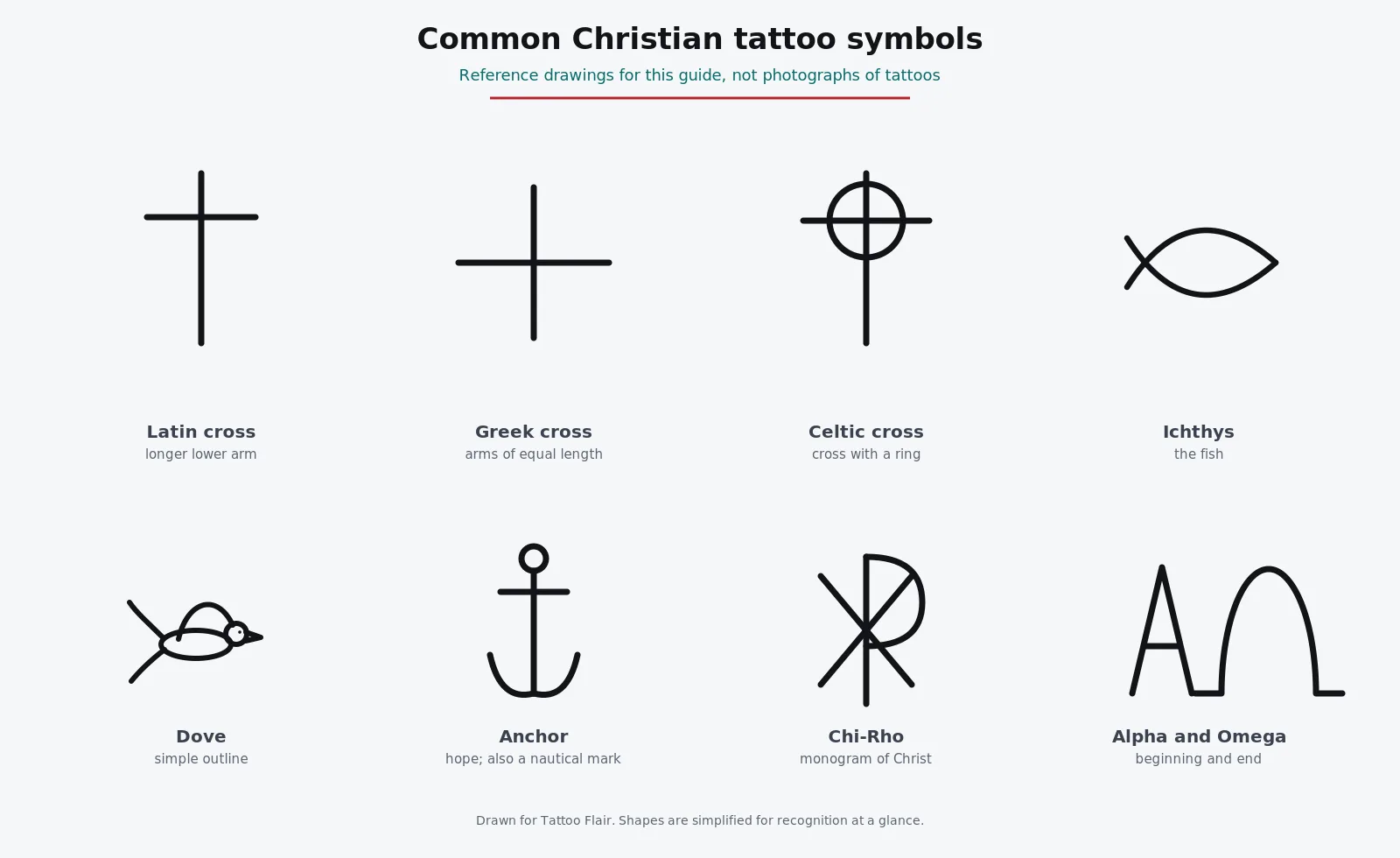
The cross
The cross is the symbol people ask for most, and it is the easiest one to make too generic. A Latin cross (the longer lower arm) reads clearly at almost any size. A Greek cross, with arms of equal length, feels more like a mark or a seal. Celtic crosses add a ring and often some knotwork, which needs more room if you want the weaving to stay readable in ten years.
On very small pieces, extra floral or diamond work around the cross is the first thing to soften as the tattoo heals. If you want a petite cross, look at healed examples of the same size in your artist’s portfolio, not only fresh photos. Our Faith & Christian hub collects smaller designs, including petite biblical tattoos readers save when they want something quiet.
Placement matters as much as style. The inner wrist, collarbone and the back of the shoulder all suit a small cross. Fingers and the hairline behind the ear can work, but they fade faster and often need a bolder line than people expect. The placement guide and the Placement & Pain Finder can help you compare those spots before you book.
Ichthys, the fish
The ichthys is two curved lines that form a fish. Early Christians used it as a discreet sign, and that history is why so many people still want it small. It is one of the few faith symbols that stays clear when it is truly tiny, because the silhouette is simple.
Where it struggles is when someone adds scales, an eye and a banner of text at the same miniature size. The simple outline holds. The engraved-looking version needs more space, closer to the size of a coin than a grain of rice. Inner ankle, behind the ear and the side of a finger are common homes for the outline. If you want the fish plus a short verse, give the verse its own line rather than cramming it inside the shape.
The dove
A dove can stand for the Holy Spirit, for peace or for a particular prayer you come back to. As a tattoo it behaves like any other small bird: the eye, beak and feather splits are the details that disappear first if the bird is too small or the lines are too fine.
Ask your artist whether they would rather suggest the dove with a few confident lines or draw a more natural bird at a larger size. Both can be beautiful. What rarely works is a highly detailed dove the size of a thumbnail. If you like the idea of a dove with an olive branch, look at how much space the branch needs so it does not turn into a scribble beside the body.
The anchor
Hebrews 6:19 describes hope as “an anchor of the soul,” and that is the line most people have in mind when they ask for this one. The anchor also shows up in older nautical tattooing, so you can take it in a fine-line direction or toward American traditional, with a thicker shank and a clean, dark fluke.
Traditional anchors age especially well because the shape was designed to stay readable after years of sun and work. A fine-line anchor can look graceful on a collarbone or inner forearm, but it needs a little more visual weight than a whisper-thin outline. If you are torn between styles, our styles hub and the later notes on real traditional work are useful to look at side by side.
Alpha and Omega
Alpha and omega are the first and last letters of the Greek alphabet, used in Revelation for God as beginning and end. As a tattoo they can stand alone, sit on either side of a cross or pair with a short verse.
The risk is treating them as decoration your artist has to invent from memory. Bring a clear reference for the letterforms you want, especially if you care about a particular Greek style. Letters are like any other script: below a certain height they melt together. If you want both letters and a cross in one small piece, let your artist tell you honestly whether that design wants to be larger.
Chi-Rho
The Chi-Rho overlays the first two letters of the Greek word for Christ (chi and rho) into a single monogram. It is one of the oldest Christian marks, and it has a graphic strength that tattoos well, closer to a seal than to a picture.
Because the lines cross, the design needs enough space for the intersection to stay crisp. It looks at home as a small sternum or upper-arm mark, or as the centre of a larger ornamental piece. If you have only seen it in jewelry, look at a few large, simple drawings before you shrink it. Jewelry can hide muddiness that skin will not.
Crown of thorns
A crown of thorns can wrap a wrist, circle a cross or stand as a small wreath on its own. It is a heavier subject than a dove or a fish, and it reads that way on skin. The thorns and shadows need contrast. A pale, hair-thin version can heal into a faint bracelet that no longer says what you meant.
If you want it to wrap a wrist or ankle, ask how the design will look when your joint bends. Circular pieces that are planned only on a flat paper sketch sometimes gap or pinch once they go around a real wrist.
Sacred heart and other pictured symbols
Some readers ask for a sacred heart, a lamb, a loaf and cup, or a simple praying-hands outline. These are pictures more than marks, so they follow the same rule as any illustrated tattoo: the more detail you want, the more room you should give it.
I would rather see a slightly larger sacred heart that still has a clear flame and crown than a tiny one that heals into a red blur. If you are drawn to pictured symbols, look at healed colour work in your artist’s portfolio, not only black fine-line grids.
When the symbol is actually a verse
A lot of “symbol” requests are verses in disguise. People want the feeling of John 3:16 or Psalm 23 without wearing a paragraph. Sometimes a symbol does that job better than abbreviated text. Sometimes a short clause in a clear script is the more honest choice.
If you are deciding between a mark and words, read Short Bible Verse Tattoos next. It includes thirty shorter verses and notes on translation, script and the size where letters tend to last. For small faith pieces that already exist on real skin, I also keep a growing Real Ink collection of fine-line Christian tattoos by working artists.
A short checklist before you book
- Write the meaning in one sentence and share it with your artist.
- Bring a few references you like and one you do not, so they can see the line.
- Ask to see healed work at the size you want, especially for fine-line crosses and doves.
- Confirm any accompanying verse word for word, in the translation you use.
- Leave room. A slightly larger, clearer mark will serve you longer than a crowded miniature.
If you want to keep browsing after this, start with the Faith & Christian hub or the notes on how fine-line tattoos heal and age. And if a design you love belongs to a living artist, take that artist’s name into your consult rather than asking someone else to copy it line for line.
